
What AI-assisted medical record analysis actually looks like in practice
From manual extraction to structured chronology, source-linked traceability, record interrogation and drafted output — what meaningful AI assistance changes about the medico-legal workflow.
Dr Khaled Abdel-Aziz PhD FRCP
Consultant Neurologist & Medical Co-founder, ClinLexis
In discussions around artificial intelligence in medico-legal work, the conversation often remains at a high level. There is general agreement that the volume of medical records is increasing, that manual workflows are under pressure, and that technology may have a role to play. However, what is less often clear is what that actually looks like in day-to-day practice.
From a practical perspective, the question is straightforward: how does AI meaningfully assist with the review and analysis of medical records in a real case?
Starting point: the same problem
The starting point remains unchanged.
A set of medical records is received — often large, frequently unstructured, and typically drawn from multiple sources. These may include hospital notes, GP records, correspondence, therapy records, imaging reports and occupational health documentation.
Before any analysis can begin, there is a need to understand:
- The sequence of events
- The relevant clinical interactions
- The progression of symptoms and treatment
- The relationship between different parts of the record
Traditionally, this requires a manual process of reading, extracting, and organising information. The question is how that process can be supported more effectively.
Structured chronology as the foundation
One of the most immediate applications of AI in this context is the generation of structured chronologies.
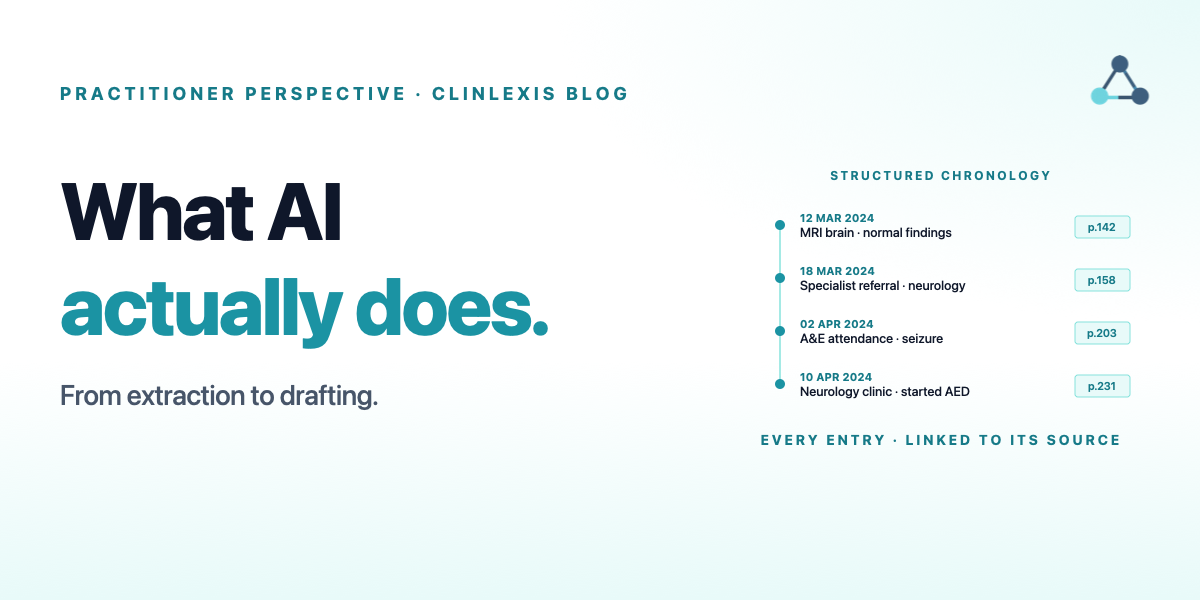
Rather than building a timeline manually, the platform analyses the records and organises events into a chronological framework, grouping related entries and presenting them in a format that can be reviewed and refined.
From a user perspective, this does not remove the need for oversight. The chronology still requires review and interpretation. However, it changes the starting point.
Instead of working from a blank page, the medico-legal professional begins with a structured representation of the records, allowing them to focus on validation, refinement and analysis rather than initial extraction.
Traceability and source linking
A key consideration in medico-legal work is not simply what is presented, but how it is supported. For that reason, any meaningful application of AI in this space must allow the user to verify outputs against the underlying records.
In practice, this means that each chronology entry or extracted point is linked directly back to its source. This allows users to move seamlessly between structured summaries and the original documentation, ensuring that any interpretation remains grounded in the evidence.
This traceability is essential. Without it, the outputs would have limited utility in a setting where accuracy and defensibility are critical.
Interrogating the record
Beyond chronology generation, another area where AI can assist is in the interrogation of records. In complex cases, a significant amount of time is spent searching for specific pieces of information:
- When did symptoms first appear?
- What treatment was provided at a particular stage?
- Is there evidence of delay or deterioration?
Rather than manually locating this information, it is possible to query the record directly. From a practical standpoint, this involves asking targeted questions and receiving structured responses based on analysis of the underlying material.
This does not replace the need for professional judgement. The responses require interpretation and verification. However, it can significantly reduce the time required to locate relevant information and to gain an overview of key issues within a large dataset.
From analysis to drafting
Then comes the transition from record review to report writing. Once the records have been analysed and a chronology established, the next step is to translate that understanding into a structured report.
This can involve:
- Summarising key events
- Describing clinical progression
- Presenting findings in a consistent format
In practice, this often means revisiting the same material and reworking it into a different structure. Where structured analysis is already available, it becomes possible to support this process more directly.
Draft outputs can be generated based on the underlying structured data, providing a starting point for further refinement. These outputs can be aligned with established formats, including user-defined templates, ensuring consistency with existing reporting practices.
As with other stages, the role of the professional remains central. The draft is reviewed, edited, and shaped into a final report. The difference now is that the initial construction of the document becomes more efficient.
Maintaining professional control
A consistent concern when discussing AI in medico-legal work is the risk of over-reliance on automated outputs. In practice, effective use of these tools depends on maintaining clear boundaries.
The role of the platform is to support:
- Extraction of information
- Structuring of records
- Initial drafting
It does not replace:
- Clinical interpretation
- Legal analysis
- Expert opinion
In that sense, the technology functions as an extension of the workflow rather than a substitute for it.
A change in emphasis
What emerges from this is not a fundamentally different process, but a shift in emphasis.
Less time is spent:
- Locating information
- Constructing basic structures
- Repeating manual tasks
More time is spent:
- Interpreting clinical detail
- Assessing significance
- Formulating opinions
From a professional perspective, this is where expertise is most valuable.
A practical perspective
From experience, one of the most challenging aspects of medico-legal work is not the analysis itself, but the preparation required to reach the point where analysis can begin. Any approach that makes that preparatory stage more efficient has the potential to improve both the quality and the timeliness of the work that follows.
The question is not whether these tools can produce output — it is whether they can support the way professionals already think and work.
Looking ahead
As with any technological shift, adoption will depend on trust, usability, and demonstrable value in real-world cases. At ClinLexis we have addressed that by implementing an introductory low monthly fee of £24.99 to lower the barrier to getting started, and are currently offering 1,000 free credits on sign-up to new users to sample the usability and outputs of the platform.
Final thought
In many ways, the most useful way to think about AI in the context of medical record analysis is not as a replacement for existing processes, but as a way of improving how those processes begin. If the starting point is clearer, more structured, and easier to interrogate, the work that follows becomes more focused — and in medico-legal practice, that focus is where real value lies.